Nicomachean Ethics Summary: Unlock Aristotle’s Timeless Guide to Virtue
Aristotle’s Nicomachean Ethics is a famous book about how to live a good life. It is one of the oldest and most important works in philosophy. Aristotle tries to explain what happiness really means. He also tells us how to find it by living well and doing good things.

What Is the Nicomachean Ethics About?
The book asks a big question: What is the best way to live? Aristotle believes that every person wants to be happy. But happiness is not just feeling good for a moment. It is about living well for a long time. He calls this happiness eudaimonia. This means more than just pleasure. It means doing what is right and using your mind well.
Aristotle says all people have a special job or function. That job is to use reason and think. So, to be happy, people must live by reason. This means making good choices and having good habits. These good habits are called virtues.
Book I: The Highest Good
Aristotle starts by saying that every action aims at some good. For example, we work to earn money, and we study to learn. But these things are not the highest good. The highest good is something we want for its own sake, not for something else.
This highest good is eudaimonia. It means living well and doing well. Aristotle says eudaimonia is an activity of the soul in line with virtue. It is not just a feeling, but a way of living.
Books II – IV: Moral Virtues
Next, Aristotle talks about virtues. Virtues are habits that help us do the right thing. They lie between two extremes. For example, too much fear is cowardice, and too little is recklessness. The right amount is courage.
Here are some key virtues Aristotle explains:
| Virtue | Explanation | Extreme 1 (Deficiency) | Extreme 2 (Excess) |
|---|---|---|---|
| Courage | Facing fear in the right way | Cowardice | Rashness |
| Temperance | Controlling physical pleasures | Insensibility | Overindulgence |
| Liberality | Giving and using money wisely | Stinginess | Wastefulness |
| Magnanimity | Proper pride and ambition | Smallness of soul | Vanity |
Aristotle believes that by practicing virtues, people build good character. This helps them make the right choices every day.
Book V: Justice
Justice is a special virtue. It is about how we treat other people. Aristotle says justice is the most complete virtue. It involves fairness in society.
There are two main types of justice:
- Distributive Justice: Fair sharing of wealth, honor, and rewards based on what people deserve.
- Corrective (or Rectificatory) Justice: Fixing wrongs by making sure people get what they lost or were cheated of.
Justice helps keep peace and trust in a community.
Books VI – VII: Intellectual Virtues and Friendship
Aristotle also talks about thinking well. He calls this intellectual virtue. It includes skills like wisdom and understanding. These virtues help us make good decisions in life.
Another important topic is friendship. Aristotle says true friendship is based on goodness. Friends want what is best for each other. Friendship supports happiness and helps us grow as better people.
Book VIII – IX: More on Friendship
Aristotle explains three kinds of friendship:
- Friendship of Utility: Based on usefulness, like business partners.
- Friendship of Pleasure: Based on enjoying time together.
- Friendship of the Good: Based on mutual respect and virtue.
The best friendship is the one based on goodness. It lasts longer and helps us become better people.
Book X: Happiness and Pleasure
Finally, Aristotle talks about pleasure. He says pleasure is good only when it comes from doing good things. True happiness is not about chasing fun. It comes from living a full life with virtue.
He also discusses contemplation. This means thinking deeply about important things. Aristotle says contemplation is the highest form of happiness. It uses our reason fully and brings true joy.
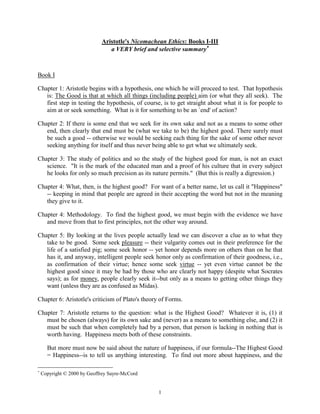
Key Ideas from Nicomachean Ethics
- Happiness (Eudaimonia): The main goal of life is to be happy by living well.
- Virtue: Good habits that help us act rightly.
- The Golden Mean: Virtue lies between extremes of too much or too little.
- Justice: Treating others fairly is essential for a good life.
- Friendship: True friends help us grow and find happiness.
- Reason: Using our mind well is key to happiness.
Why Is Nicomachean Ethics Important?
This book helps us think about what really matters in life. It shows that happiness is more than pleasure. It is about living with purpose and kindness.
Even today, people study Nicomachean Ethics to learn how to be better friends, family members, and citizens. Aristotle’s ideas still help guide people toward a good life.
Final Thoughts
Aristotle teaches us to live a balanced life. To be brave but careful. To enjoy life but not be greedy. To help others and be fair. And to think deeply about what is right.
In short, the Nicomachean Ethics is a guide to becoming a good person. It shows that happiness comes from living with virtue and reason every day.
Frequently Asked Questions
What Are The Main Points Of Nicomachean Ethics?
Aristotle’s Nicomachean Ethics focuses on achieving eudaimonia, or true happiness, through virtuous living. It highlights the “golden mean,” balancing excess and deficiency in virtues like courage and temperance. Justice, wisdom, and rational soul activity guide moral actions for a fulfilled, ethical life.
What Are The 12 Principles Of Aristotle?
Aristotle’s 12 principles focus on achieving eudaimonia through virtues: courage, temperance, liberality, magnificence, magnanimity, patience, truthfulness, wittiness, friendliness, justice, practical wisdom, and the golden mean. These guide balanced, rational actions for a happy, virtuous life.
Is Nicomachean Ethics Hard To Read?
Nicomachean Ethics can be challenging due to its ancient language and complex ideas. Reading summaries helps simplify key concepts.
What Are The Criticisms Of Nicomachean Ethics?
Critics argue Nicomachean Ethics excludes women and minorities by linking virtue to specific traits. It may reinforce social biases and lacks universal applicability. Some find its focus on rationality too narrow, ignoring emotions and cultural differences in moral values.

Similar Posts