Blue Ocean Strategy Summary: Unlock Breakthrough Growth Tactics
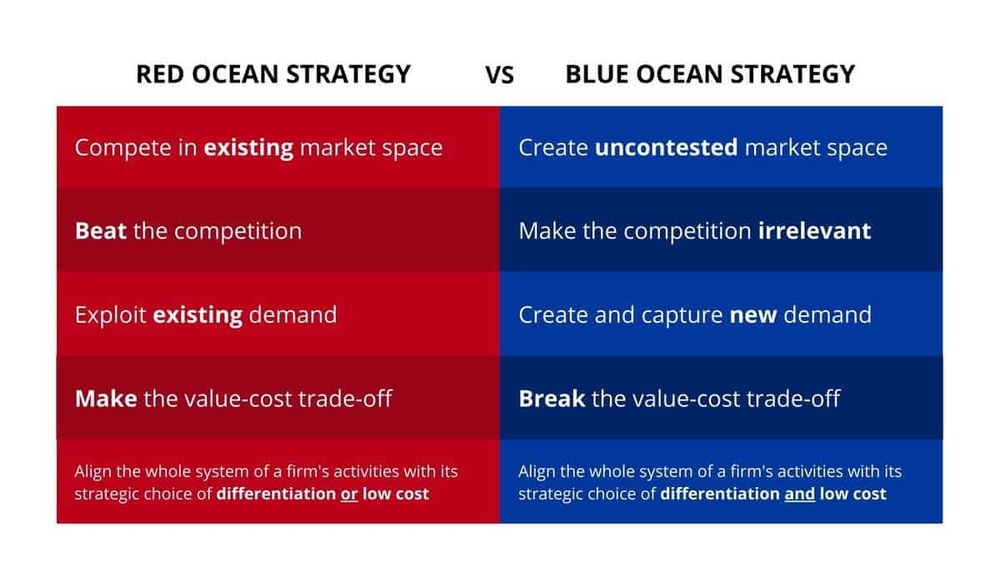
Many companies fight hard in crowded markets. This is called a “red ocean.” The red ocean is full of competition and struggle. Everyone tries to beat each other with similar products. The result? Businesses often lose money or just survive.
But what if there was another way? What if companies could leave the red ocean and find a new, calm “blue ocean”? This blue ocean is open and free from competition. It means creating new markets with fresh ideas.
What Is Blue Ocean Strategy?
Blue Ocean Strategy is a plan for businesses. It helps companies find new spaces where they have little or no competition. Instead of fighting for the same customers, businesses create new demand. This way, they grow faster and earn more.
The term comes from the book Blue Ocean Strategy by W. Chan Kim and Renée Mauborgne. The book explains how companies can move from red oceans to blue oceans.
Red Ocean vs. Blue Ocean
| Red Ocean | Blue Ocean |
|---|---|
| Many competitors | No or few competitors |
| Compete in existing markets | Create new markets |
| Fight over existing demand | Make new demand |
| Focus on beating rivals | Focus on innovation and value |
| Often leads to price wars | Offers unique products or services |

How Does Blue Ocean Strategy Work?
Blue Ocean Strategy is about two main things: value innovation and new market creation. Let’s understand both.
Value Innovation
Value innovation means making products or services better and cheaper at the same time. Usually, businesses focus on either low cost or high value. Blue Ocean Strategy says do both. This creates a leap in value for customers and the company.
New Market Creation
Instead of competing in old markets, businesses look for new areas. These markets have no competition. Companies find new customers or create new needs. This is like sailing into a blue ocean full of opportunity.
The Four Actions Framework
To create a blue ocean, companies use the Four Actions Framework. This helps them rethink their products or services.
- Eliminate: Which factors should the company stop offering?
- Reduce: Which factors should be reduced below industry standards?
- Raise: Which factors should be raised above industry standards?
- Create: Which factors never offered before should be introduced?
This framework helps companies break old rules and build new value curves.
Six Paths to Discover Blue Oceans
The authors suggest six ways to find blue oceans. These paths help companies see beyond normal competition.
- Look across alternative industries. Think about what else customers use instead of your product.
- Look across strategic groups. Find gaps between high-end and low-end products.
- Look across buyer groups. Target different customer groups in new ways.
- Look across complementary product and service offerings. Add new services or products that change the experience.
- Look across functional-emotional orientation. Shift the focus from function to emotion or vice versa.
- Look across time. Plan for future trends and changes in demand.
Example: Cirque du Soleil
Cirque du Soleil is a famous example of Blue Ocean Strategy. It created a new kind of circus. It mixed theater, music, and dance. It did not compete with traditional circuses full of animals and clowns.
Cirque du Soleil eliminated expensive animals and star performers. It raised the quality of the show and created a new experience for adults and families. This made a blue ocean where it had no rivals.

Benefits of Blue Ocean Strategy
Why use Blue Ocean Strategy? Here are some benefits:
- Less competition: No need to fight rivals every day.
- New customers: Create demand where none existed.
- Higher profits: Unique products can charge better prices.
- Growth opportunities: Open new markets and expand faster.
- Better value: Combine low cost and high value for customers.
Challenges in Blue Ocean Strategy
Blue Ocean Strategy is not easy. It needs creativity and risk-taking. Companies must leave old habits behind. They need to try new ideas and sometimes fail.
Also, new markets can be uncertain. Customers might not understand the new product. It can take time to educate the market.
How to Start With Blue Ocean Strategy
Follow these steps to begin your blue ocean journey:
- Understand your current market and customers deeply.
- Use the Four Actions Framework to rethink your offerings.
- Explore the six paths to find new opportunities.
- Test your new ideas with small experiments.
- Launch your new product or service in the new market.
- Keep improving and watch for new blue oceans.
Key Takeaways
- Blue Ocean Strategy helps companies avoid fierce competition.
- It focuses on creating new markets and new demand.
- Value innovation means offering better value at a lower cost.
- The Four Actions Framework guides how to change products.
- Six paths help find new business ideas outside usual markets.
- Success needs creativity, risk, and patience.
Frequently Asked Questions
What Is The Blue Ocean Strategy In Simple Words?
Blue Ocean Strategy means creating a new market space with unique products or services. It avoids competition and grows demand. Businesses focus on innovation and low cost to make competition irrelevant. This approach helps companies stand out and succeed by offering something new and valuable.
What Is The Blue Ocean Strategy Summary?
Blue Ocean Strategy focuses on creating uncontested market space by innovating value. It combines differentiation with low cost to open new demand and avoid competition. Companies eliminate, reduce, raise, or create factors to redefine industry boundaries and unlock growth opportunities.
What Are The 4 Elements Of Blue Ocean Strategy?
The four elements of Blue Ocean Strategy are: eliminate factors the industry takes for granted, reduce factors below industry standards, raise factors above industry standards, and create new factors the industry has never offered.
What Are The Six Principles Of Blue Ocean Strategy Explained?
The six principles of Blue Ocean Strategy are: look across alternative industries, strategic groups, buyer groups, complementary offerings, functional-emotional appeal, and time. These guide companies to create uncontested market space and unlock new demand.
Conclusion
Blue Ocean Strategy is a smart way to grow a business. It offers a fresh approach. Instead of battling in crowded places, companies sail to open waters. Here, they find new customers and create new value.
This strategy is about thinking differently. It asks businesses to break old rules. It encourages bold moves and new ideas. For any company wanting to grow, Blue Ocean Strategy is a useful guide.

Similar Posts